
Quick answer: Meal prep means preparing some or all of your food ahead of time so meals are easier to assemble during the week. And beginners don’t need to cook seven complete meals. So, this beginner meal prep guide starts you with 2-3 days, one prep method, only the portions you actually need and safe refrigerator or freezer storage.
Most meal prep advice assumes you want to spend Sunday afternoon cooking seven identical containers of chicken and rice. But you almost certainly don’t and you don’t have to.
The goal of meal prep isn’t a full week of finished meals; It’s fewer weekday decisions. And this beginner meal prep guide walks you through the whole sequence in order (choose a method, plan portions, shop, cook, cool, store, and reheat) so your first prep session is small enough to actually finish. Also, when you’re short on time, it pairs well with simple ways to eat healthy when you have no time.
What Is Meal Prep, Exactly?
What meal prep actually means
A few terms get used interchangeably and untangling them makes the rest of this easier:
- Meal planning is deciding what you’ll eat. And there’s no cooking involved.
- Meal prep is doing some of the cooking or assembly in advance.
- Make-ahead meals are finished dishes you cook now and eat later.
- Batch cooking is making one large quantity of a single dish.
- Component prep is cooking parts (a protein, a grain and some vegetables) that get combined later.
- Planned leftovers means deliberately cooking extra at dinner to cover tomorrow’s lunch.
You can meal plan without prepping and you can prep without a plan. Doing both is what makes a week run smoothly.
The 4 main types of meal prep
| Method | What you prepare | Best for |
| Full meals | Complete portions in individual containers | Grab-and-go lunches |
| Component prep | Protein, grain and vegetables stored separately | Flexible meals |
| Batch cooking | One large dish, portioned out | Soups, chili and casseroles |
| Planned leftovers | Extra servings from dinner | Lowest-effort approach |
Which Meal Prep Method Is Best for Beginners?
There isn’t one right method – there’s one that fits your week. Find your row:
| If you… | Start with… |
| Want grab-and-go lunches | Full meals |
| Hate eating the same meal twice | Component prep |
| Have limited cooking time | Batch cooking |
| Already cook dinner regularly | Planned leftovers |
| Have only one appliance available | Adapt component or batch prep to that appliance |
If you’re not sure, start with component prep. Additionally, it’s the most forgiving default because one batch of roasted vegetables and one batch of chicken can become four different meals depending on what you add. Full meals lock you into a decision you made days ago and component prep lets Thursday-you have an opinion.
Batch cooking is the better pick if cooking time is your real constraint, since one pot of chili is one cleanup. Moreover, planned leftovers is the lowest-effort entry point of all: cook one extra portion tonight and you’ve technically meal prepped.
Ingredient overlap is what makes any of these work. Choosing portioned meals that share a base (the same grain and the same roasted vegetables) cuts your shopping list and your active cooking time at the same time. You may also love to browse meal-prep-friendly recipes to see which ones share ingredients before you commit to a method.
How to Plan Your First Week of Meal Prep
Start with your real calendar
Before you plan a single meal, look at the actual week: workdays, meals out, travel, family dinners and nights when cooking something fresh is genuinely easier than reheating. Therefore, most first-timers over-prep because they plan for an imaginary week where they eat at home fourteen times.
Count portions before shopping
Use one line of arithmetic:
People × planned meals = required portions
Then subtract:
- Meals you’ll eat out
- Leftovers already in the fridge
- Meals you’d rather cook fresh
The number of what’s left on your grocery list is usually much smaller than people expect.
The minimum-viable first week
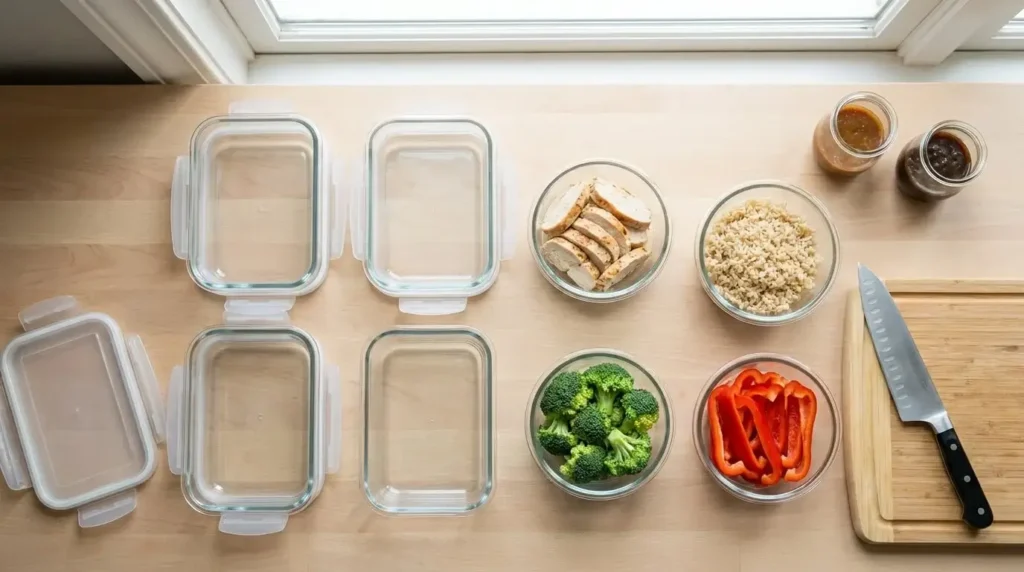
Here’s the target for prep session number one:
- 2 prepared lunches
- 1 freezer portion
- 1 easy breakfast option (overnight oats, egg cups or portioned yogurt)
- Fresh dinners or leftovers for everything else
That’s it: four things when I ran this exact plan, it took less time than I’d budgeted and used five containers instead of the ten I’d pulled out, which turned out to be the most useful thing I learned, because container shortage is what kills the second week for most people.
Add one more habit: a midweek 15-minute reset on Wednesday. First, wash and re-chop vegetables, then cook a fresh grain or roast one more sheet pan. Also, fifteen minutes midweek does more for a real week than an extra hour on Sunday. You can also keep a few easy recipes you already know in rotation so the reset never requires a new recipe.
What Should You Buy and Prep?
Use ingredient categories instead of seven recipes
Shop by category, not by recipe:
- Protein
- Grain or starch
- Vegetables
- Legumes
- Fruit
- Sauce or dressing
- Crunchy toppings
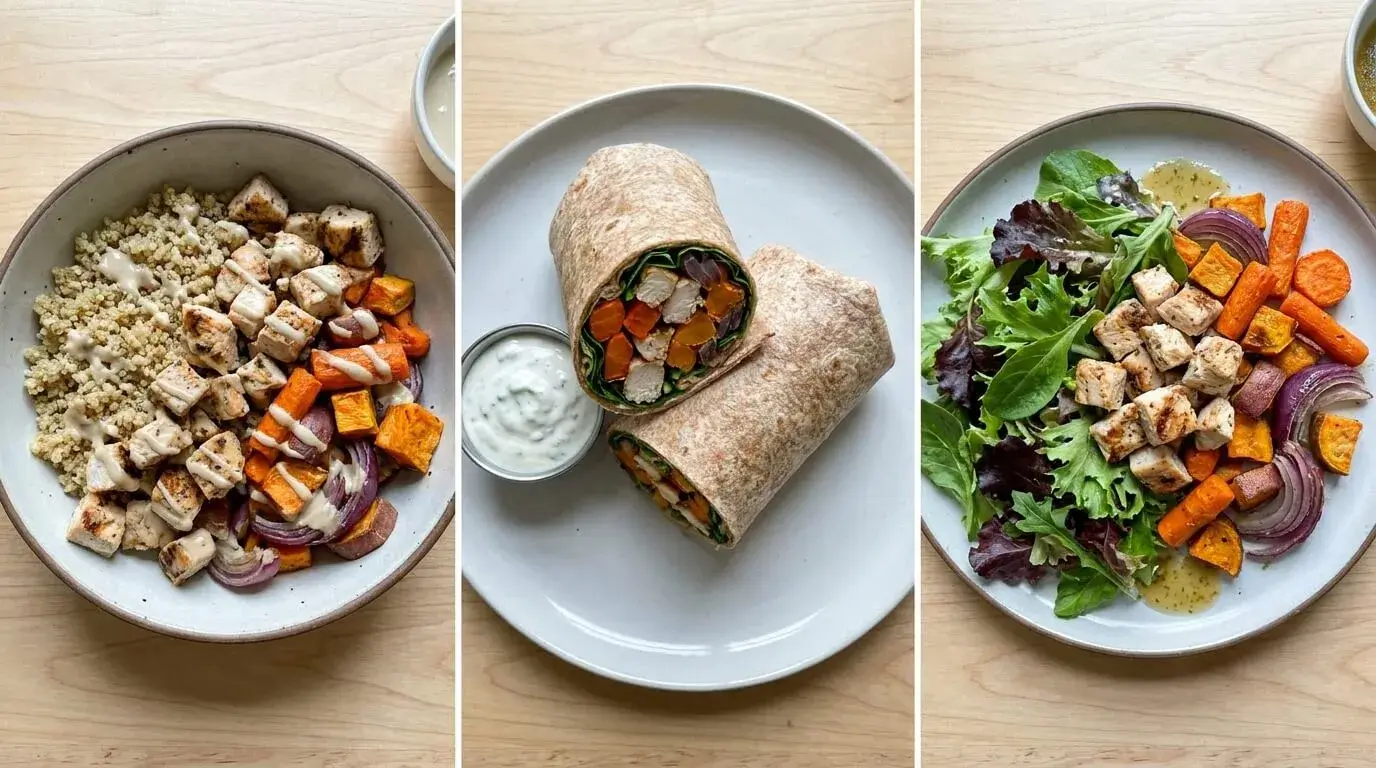
One example of ingredient overlap in action: chicken + rice + roasted vegetables becomes a bowl, a wrap, a salad or a dinner plate just by changing the sauce and fresh toppings. Same basket, four meals. Additionally, if you want protein-forward options, high-protein recipes fit this structure well and chickpeas or lentils slot straight in from the legume row.
Minimum equipment
You need less gear than the internet suggests:
- Sheet pan
- Pot or saucepan
- Skillet
- Cutting board
- Chef’s knife
- Mixing bowl
- Food thermometer
- Storage containers
A slow cooker, pressure cooker or air fryer is helpful if you own one, but none of them is required to start.
The Beginner Meal Prep Cooking Workflow
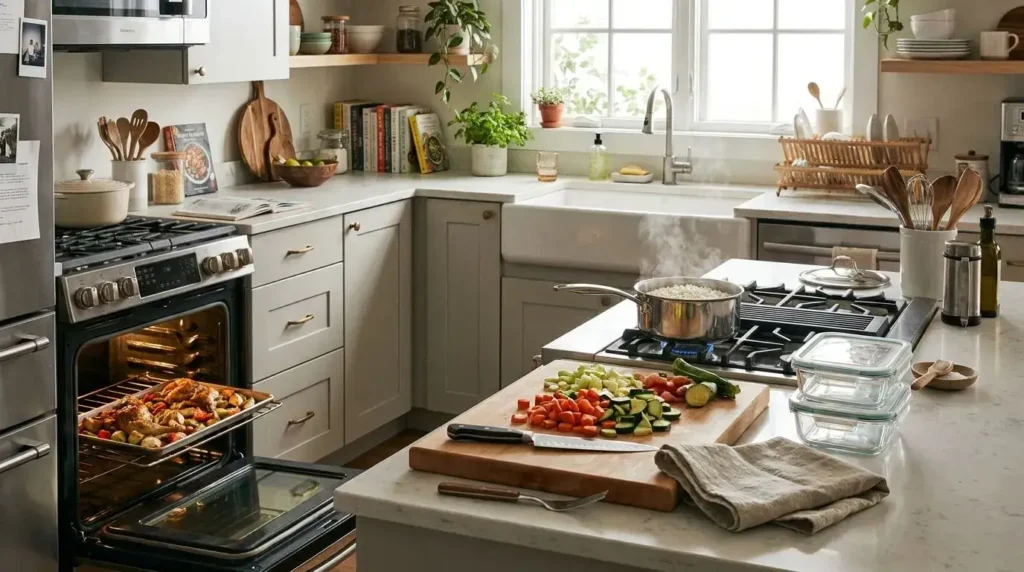
A simple 90-minute prep-day sequence
This is a starter workflow example, not a guaranteed universal time – your kitchen, menu and knife skills all shift it.
| Time | What you’re doing |
| 0-10 min | Check pantry, preheat oven and start the longest-cooking item |
| 10-25 min | Chop vegetables and season protein |
| 25-50 min | Oven and stovetop cooking while you assemble cold components |
| 50-65 min | Finish grains, protein and vegetables |
| 65-75 min | Make sauces, also portion ingredients |
| 75-90 min | Cool, pack, label and refrigerate or freeze |
The order matters more than the clock. Because anything with passive cooking time (rice, roasting vegetables, simmering beans) goes first, so it’s working while you handle everything else.
Cooking temperatures that matter
Meal prep sits in the fridge longer than a normal dinner, so cooking to a safe temperature the first time matters more than usual. Instead, use a food thermometer rather than color or timing.
| Food | Minimum internal temperature |
| Chicken and turkey | 165°F |
| Ground beef, lamb, veal | 160°F |
| Beef, lamb, veal steaks, chops, roasts | 145°F + 3-minute rest |
| Fish and shellfish | 145°F |
| Eggs | 160°F |
| Leftovers | 165°F |
These are the safe minimum internal temperatures published by the USDA Food Safety and Inspection Service, which also publishes a full temperature chart covering fish, eggs and everything else you’re likely to prep.
How to Store Meal Prep Safely
The fridge/freezer rule
Storage is where good prep quietly goes wrong and the rules are simple enough to memorize.
Keep your refrigerator at 40°F or below. And use most cooked leftovers within 3-4 days refrigerated and freeze anything you won’t get to in that window. Also, get perishable food into the fridge or freezer within 2 hours of cooking (1 hour if the room is above 90°F). In addition to this, cool food in shallow containers so it drops through the danger zone quickly instead of sitting warm in the middle of a deep tub.
Freezing past those windows is mainly a quality question rather than a safety one: frozen leftovers stay safe indefinitely, though USDA notes they tend to lose moisture and flavor after about 3-4 months. All of this follows USDA guidance on leftovers and food safety.
Sunday-to-Friday storage map
| Day | Best approach |
| Prep day | Refrigerate near-term portions, freeze the rest |
| Monday-Tuesday | Eat refrigerated meals |
| Wednesday | Midweek reset; refresh or cook additional components |
| Thursday to Friday | Use frozen portions or freshly prepared components |
This map is a planning tool, not a promise. So, not every food safely lasts until Friday in the refrigerator; the actual window depends on the food, how it was cooked and how quickly it cooled. When you’re in doubt, freeze on prep day rather than hoping.
Label every container
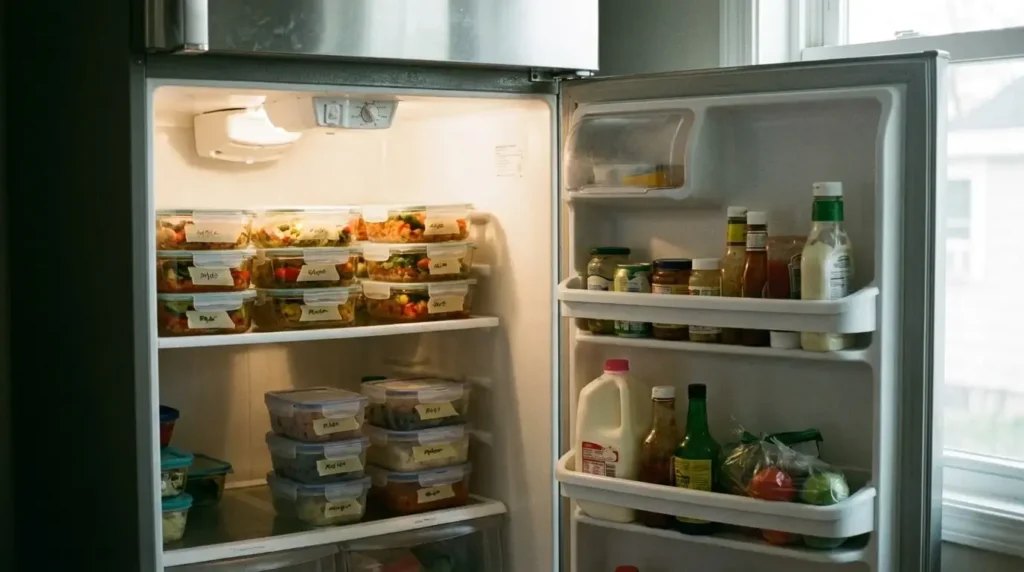
Write three things on every lid:
Meal + prep date + eat-or-freeze plan
“Chicken bowls / Tue / eat by Fri” takes four seconds and removes every guessing game later in the week. Remember: Forgotten food is almost always unlabeled food.
How to Keep Meal Prep From Getting Soggy
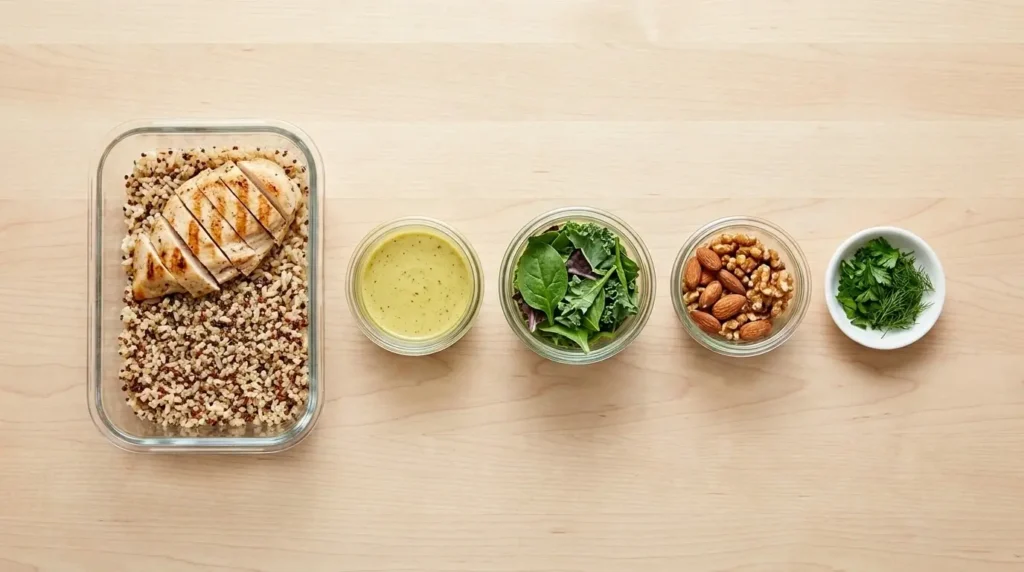
Food safety and food quality are two different questions. Something can be perfectly safe and still be disappointing. Also, sogginess is a quality problem and it’s solved by deciding what shares a container.
| Food | Best approach |
| Cooked grains | Store separately or underneath the protein |
| Dressing | Always separate |
| Leafy greens | Keep dry and away from dressing |
| Fresh herbs | Add later |
| Crunchy toppings | Add immediately before eating |
| Avocado | Prefer fresh |
| Crispy foods | Cook or reheat close to serving |
| Saucy meals | Usually fine stored together if the texture holds |
The pattern: wet things and crisp things shouldn’t sit together for three days. And roasted broccoli held up best in my containers; anything dressed in advance did not.
How to Reheat Meal Prep Without Ruining It
Reheat by format, not by default microwave setting.
| Meal format | Quality tactic |
| Grain bowl | Reheat the base and protein; add cold toppings after |
| Soup or stew | Reheat covered, stirring partway through |
| Pasta | Add a splash of liquid before heating |
| Wrap | Warm the filling, assemble after |
| Salad | Don’t reheat greens; warm the protein separately |
| Casserole | Cover to hold moisture in |
Whatever the format is, refrigerated leftovers should reach 165°F. Additionally, USDA also recommends covering food and rotating it during microwave reheating, since microwaves leave cold spots. So, check the temperature in a few places rather than assuming the whole container is hot.
How to Make One Prep Session Feel Like Several Meals
One grocery basket → three meals
Start with four things:
- Base: rice or quinoa
- Protein: chicken, tofu or chickpeas
- Vegetables: one big sheet pan – roasted
- Sauces: two contrasting options
Now build:
- Bowl – base + protein + vegetables + sauce one
- Wrap – protein + vegetables + sauce two in a tortilla
- Salad or plate – vegetables + protein over greens, sauce thinned into a dressing
The two-sauce variety system
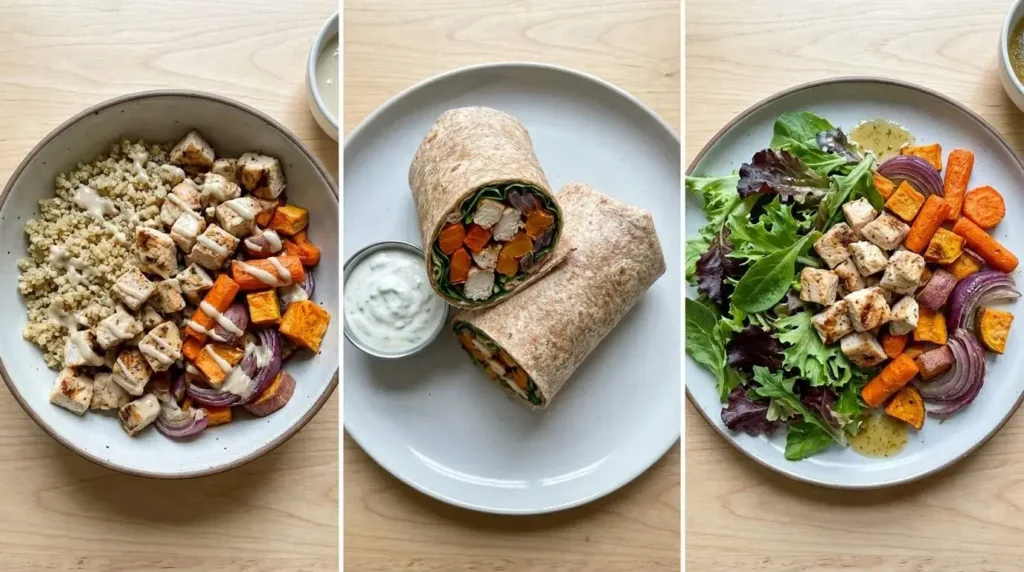
Two sauces do more for variety than two extra recipes. For example: A lemony yogurt sauce and a soy-sesame or harissa-style sauce turn the same components into meals that taste unrelated. And swapping the serving format does the rest.
This works for most dietary patterns too – the same structure holds with vegan recipes or gluten-free recipes if you change the protein and base.
Common Beginner Meal Prep Problems
| Problem | Likely cause | Fix |
| Soggy vegetables | Moisture trapped in the container | Separate wet and crunchy items |
| Dry chicken | Overcooked, then over-reheated | Use a thermometer; reheat gently with a little liquid |
| Too much food | Portions planned without checking the calendar | Count actual meals first |
| Food gets boring | One flavor profile all week | Change sauces and serving formats |
| Plans changed | No freezer or fallback plan | Freeze or repurpose appropriate portions |
| Too many ingredients | Too many unrelated recipes | Increase ingredient overlap |
For the nights that go sideways, keep a short list of fast dinners for nights when plans change and a couple of 15-minute meals you can make without thinking.
If your week changes
Run it through three questions:
- Will you eat it within the safe refrigerated period? → Refrigerate it.
- No? → Freeze an appropriate portion now, while it’s still in good shape.
- Unsure or it’s been sitting longer than you can account for? → Don’t gamble with it.
Nutrition Information: Building a Balanced Meal
Meal prep doesn’t change what makes a meal balanced; it just decides it ahead of time.
A useful general framework is Harvard’s Healthy Eating Plate, which builds meals around vegetables and fruit, whole grains, healthy protein and healthy oils.
Applied to prep, that means each container gets a vegetable, a base, a protein and a fat – usually delivered through the sauce or a drizzle of olive oil. Also, filling those four slots is enough structure for most people.
This is general information, not individualized nutrition or medical advice. If you have specific health goals or conditions, talk to a qualified professional rather than following a fixed calorie or macronutrient target you found online.
FAQ
What is meal prep?
Meal prep is preparing food ahead of time so weekday meals are faster to put together. It can also mean full portioned meals, separate components like grains and proteins, one big batch dish or simply cooking extra at dinner for tomorrow.
How do beginners start meal prepping?
Start with 2-3 days, not seven. For this, pick one method, check your real calendar and prep a minimum-viable week: two lunches, one freezer portion, one easy breakfast and fresh dinners for the rest. And expand only after that feels routine.
How many days should a beginner meal prep?
Two to three days is the right starting point. Also, refrigerated cooked leftovers are generally used within 3-4 days, so prepping beyond that means freezing some portions. Moreover, short prep sessions also mean less food wasted while you learn what you actually eat.
What are the types of meal prep?
There are four: full meals (complete portioned containers), component prep (protein, grain and vegetables stored separately), batch cooking (one large dish divided up) and planned leftovers (extra servings from dinner). Among these, component prep is the most flexible starting point for beginners.
How long does meal prep last in the fridge?
Most cooked leftovers should be used within 3-4 days when refrigerated at 40°F or below, according to USDA guidance. Meaning, anything you won’t eat in that window should go into the freezer on prep day rather than later in the week.
Can you freeze meal prep?
Yes, freezing is the best fallback when plans change. First, cool food quickly in shallow containers, freeze in single portions and label with the meal name and date. Also, frozen food stays safe indefinitely, though quality declines over longer storage periods.
How do you keep meal prep from getting soggy?
Store wet and crunchy components separately. And keep dressings, leafy greens, fresh herbs and crunchy toppings in their own containers and add them right before eating. Additionally, grains go under the protein and crispy foods are best cooked or reheated close to serving.
What are common meal-prep mistakes?
Prepping too much food, planning around an imaginary week instead of a real calendar, cooking seven unrelated recipes with no ingredient overlap, skipping labels and dressing salads in advance. And each one is fixed by starting smaller and reusing the same core ingredients.
Your next step: don’t plan a week. Plan one prep session (two lunches, one freezer portion, one breakfast) and see how many containers you actually use. That single session teaches you more than any beginner meal prep guide can and it’s small enough that you’ll finish it.
5 thoughts on “The Complete Guide to Meal Prepping for Beginners: Plan, Cook & Store”