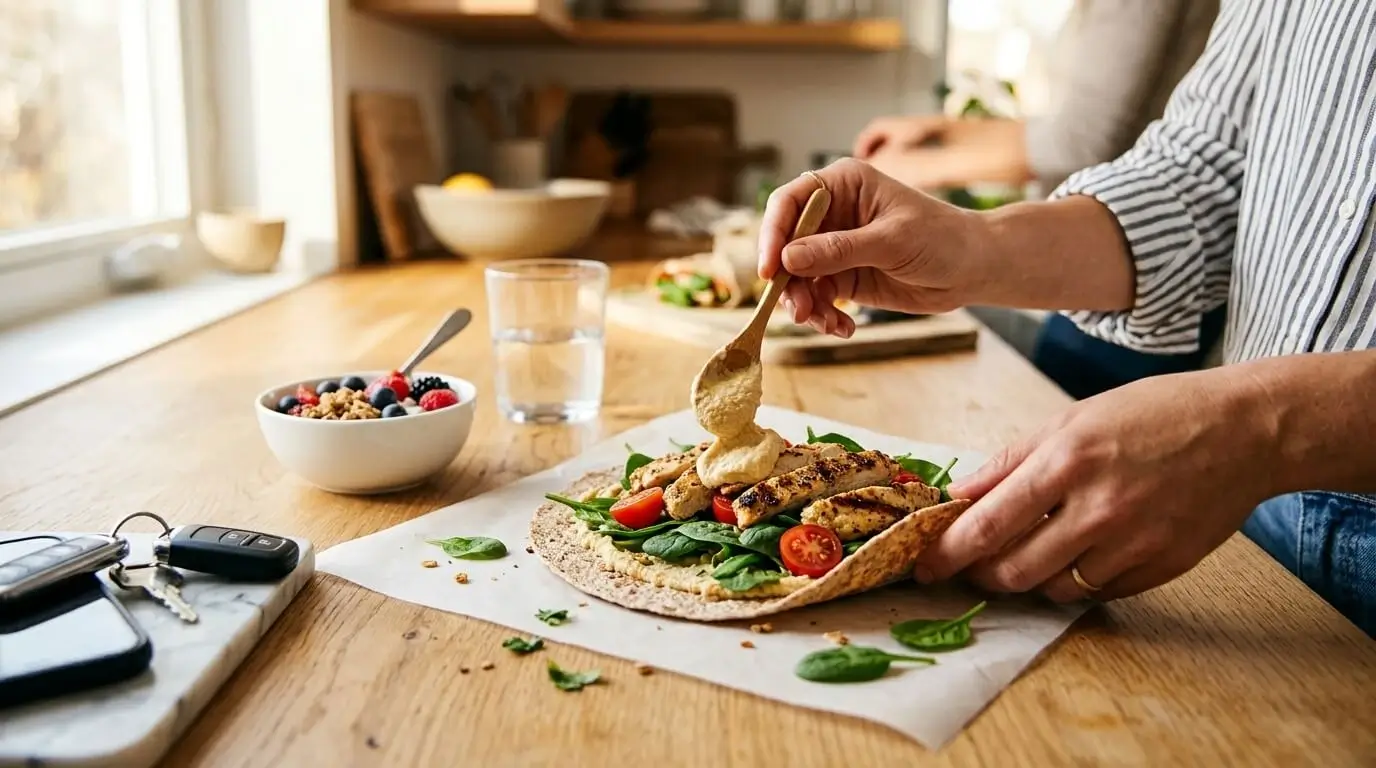
You already know what healthy eating looks like. More vegetables. Less junk. Real food instead of the drive-thru. But unfortunately, that’s not the real problem.
The problem is time.
When your day is packed with work, kids, commutes, deadlines or a shift that ends at midnight, “eat more vegetables” feels like advice from someone who’s never been busy. So you grab whatever’s fast, promise yourself you’ll do better tomorrow and the cycle repeats.
Here’s the good news: eating healthy when you’re short on time isn’t about willpower or cooking like a chef. It’s about building a simple system that makes the healthy choice the easy choice – even on your worst and most chaotic days.
This is the complete guide. And in this, you’ll get quick-win meals for every part of the day, a stocked-kitchen blueprint, a decision tree for when you have zero minutes to think, meal-prep and budget strategies and lastly, my honest tips for eating out, traveling and surviving the office snack drawer. Bookmark it. You’ll come back.
Now, let’s build your system.
Why Busy Schedules Lead to Unhealthy Eating
Quick answer: When you’re short on time, your brain defaults to whatever is fastest and most familiar – usually processed, sugary or fast food. Research consistently names lack of time as one of the top barriers to healthy eating, because cooking from scratch competes with everything else demanding your attention.
This isn’t a personal failing. It’s how humans are wired.
Studies on eating behavior repeatedly find that a perceived lack of time is one of the leading reasons people reach for fast food and convenience meals. Additionally, that “eating on the run” is linked to lower vegetable intake and higher consumption of fast food and sugary drinks. And when time is tight, people lean on takeout, prepackaged meals and whatever can be microwaved in a minute.
Those convenience foods add up in quiet ways, too. According to the CDC, most of the sodium we eat doesn’t come from the salt shaker; it comes from packaged and prepared foods like breads, pizza and deli meats. So the busy-day habit of grabbing whatever’s fastest doesn’t just crowd out vegetables; it slowly pushes up sodium and added sugars without you noticing.
There’s also the meal-skipping trap. Skipping meals (especially breakfast) is associated with poorer overall diet quality. When you skip, you usually end up hungrier later, which makes the fast, sugary and high-calorie option almost impossible to resist.
So the enemy isn’t laziness. It’s friction. Every extra step between you and a healthy meal – planning, shopping, chopping, cooking and cleaning – is a chance for a busy day to win.
The fix: Remove the friction. The rest of this guide is one long strategy for doing exactly that.
Key takeaway: Busy people don’t eat poorly because they don’t care. They eat poorly because the healthy option takes too many steps. Simply, cut the steps and healthy eating gets automatic.
The Mindset Shift: Progress Over Perfection
You need this one shift before a single grocery list or recipe, because it’s the thing that keeps people going after week one.
You do not need a perfect diet. You need a repeatable one.
Most people quit healthy eating because they aim for a magazine-perfect, all-organic, home-cooked ideal that no busy human can sustain. Then they miss one day, feel like they “failed,” and give up entirely.
Flip it. Aim for better, not perfect.
A rotisserie chicken with a bag of pre-washed salad is a win. Greek yogurt instead of a pastry is a win. Adding one vegetable to a frozen meal is a win. These small and unglamorous choices – repeated hundreds of times a year – beat a “perfect” plan you abandon in a week.
The Minimum Viable Healthy Day
Borrow this idea from the startup world: define the smallest version of a healthy day you can hit, even when everything goes wrong.
Your Minimum Viable Healthy Day might be:
- One serving of protein at each meal
- One piece of fruit or one vegetable at some point
- Water instead of one sugary drink
- No skipped meals
That’s it. That’s the floor. And on good days you’ll do far more. But on the worst days, hitting the floor keeps the habit alive and the habit is what matters over months and years.
Key takeaway: Consistency beats intensity. A “good enough” meal you’ll actually eat is healthier than a perfect one you won’t make.
Common Mistakes That Make Healthy Eating Harder
Most people sabotage themselves in the same handful of ways. Spot yourself here and half the battle’s done.
| The Mistake | Why It Backfires | The Fix |
| Empty fridge, no plan | You’ll order takeout by default | Keep a few “backup meals” always stocked (more below) |
| Skipping meals to “save time” | You overeat junk food later | Keep grab-and-go options ready |
| Trying to cook elaborate meals | Too many steps, so you quit | Assemble instead of cooking |
| Shopping without a list | You buy snacks, forget staples | Shop by category, not by craving |
| All-or-nothing thinking | One “bad” meal ends the whole plan | Aim for better, not perfect |
| Relying on willpower | Willpower runs out by 6 p.m. | Design your environment so the easy choice is healthy |
| Buying only fresh produce | It rots before you use it | Stock frozen and canned too |
The biggest one? Depending on willpower. Willpower is a limited resource and a busy day drains it fast. Systems don’t get tired, that’s why we’re building systems.
The 5-Minute Healthy Eating Formula
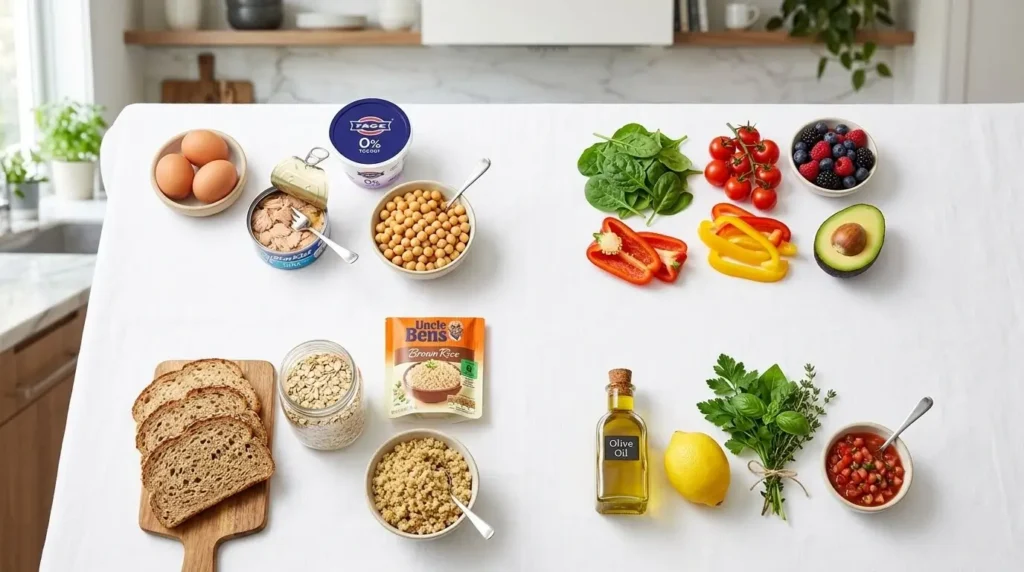
Quick answer: A healthy meal in 5 minutes needs just four parts: a protein, a produce (fruit or veg), a smart carb and a splash of flavor. Pick one from each and you have a balanced meal – no recipe, no stove and no stress.
This is the core of everything. Once it’s in your head, you’ll never stare into the fridge feeling stuck again.
Protein – keeps you full and steadies your energy: Eggs, Greek yogurt, canned tuna or salmon, rotisserie chicken, beans, lentils, chickpeas, cottage cheese, hummus, edamame and nuts.
Produce – fiber, vitamins and volume so you feel satisfied: Baby spinach, cherry tomatoes, bell peppers, cucumber, pre-washed salad, frozen veg, berries, banana, apple, avocado and baby carrots.
Smart carb – steady energy instead of a crash: Whole-grain bread or wrap, oats, brown rice (microwave pouch), quinoa, whole-grain crackers, sweet potato and whole-grain pasta.
Flavor – the part that makes you actually want to eat it: Olive oil, lemon, salsa, hot sauce, herbs and spices, mustard, a sprinkle of feta, tahini and balsamic.
How to use it
Mix and match. Sixty seconds of assembly and you’re done:
- Whole-grain wrap + hummus + spinach + rotisserie chicken + a squeeze of lemon
- Greek yogurt + berries + a handful of nuts + a drizzle of honey
- Canned tuna + pre-washed salad + whole-grain crackers + olive oil and lemon
- Microwave brown rice + canned chickpeas + frozen peas + salsa
The Healthy Plate Shortcut
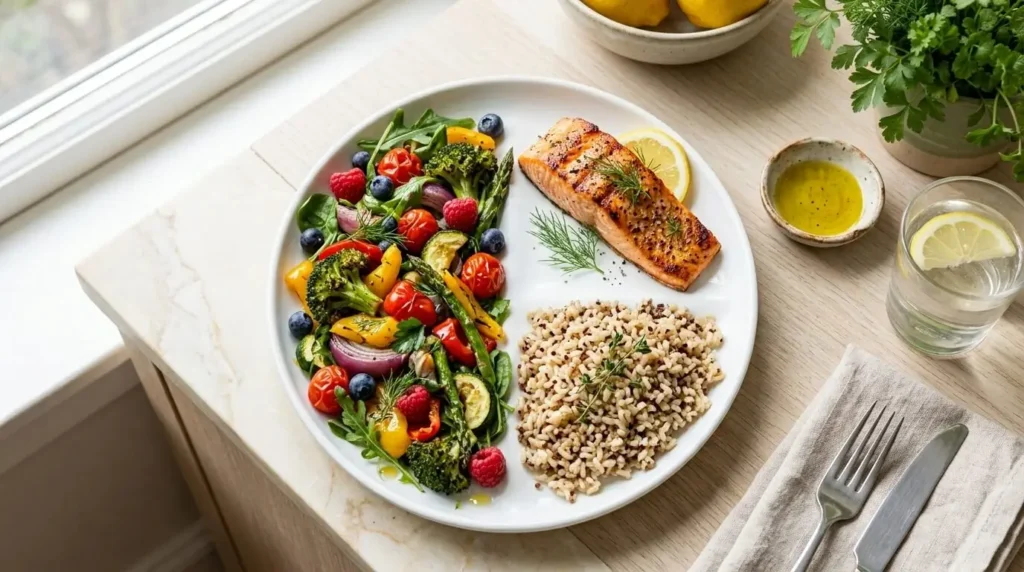
When you want a visual instead of a checklist, use the plate method – the same balance recommended by Harvard’s Healthy Eating Plate:
- ½ your plate: vegetables and fruit (load up here)
- ¼ of your plate: a healthy protein
- ¼ your plate: a whole grain or other smart carb
- A little healthy fat (like olive oil) and water to drink
You don’t need to measure anything. Just glance at your plate and adjust. Too much beige? Add color and this one habit quietly improves almost every meal.
Key takeaway: Healthy eating is assembly, not cooking. Protein + produce + smart carb + flavor = a real meal in five minutes.
The “No Time Today” Decision Tree
Some days you have twenty minutes. And some days you have zero and a screaming toddler. Instead of deciding in the moment (when your judgment is worst), decide now, based on time.
How much time do you honestly have right now?
➤ 0 minutes: “I need to eat immediately.” Grab a backup: Greek yogurt, a banana with peanut butter, a handful of nuts and an apple, a protein bar, string cheese and fruit or leftovers straight from the fridge. (No prep, no guilt.)
➤ 5 minutes: “I can assemble something.” Run the 5-Minute Formula. A wrap, a yogurt bowl, a can of tuna over salad, or toast with eggs you scrambled in the microwave.
➤ 15 minutes: “I can heat one thing” Microwave rice pouch + frozen veg + a protein. A quick omelet with whatever’s in the fridge. A grain bowl. A loaded baked potato.
➤ 30 minutes: “I can actually cook” A sheet-pan dinner, a stir-fry, a big salad with grilled protein or a one-pot pasta. Make extra so tomorrow’s “0-minute” day is covered.
Print this tree and stick it on your fridge. When you’re tired and hungry, you won’t have to think. You’ll just look.
Set Up Your Kitchen: The Pantry, Fridge & Freezer Framework
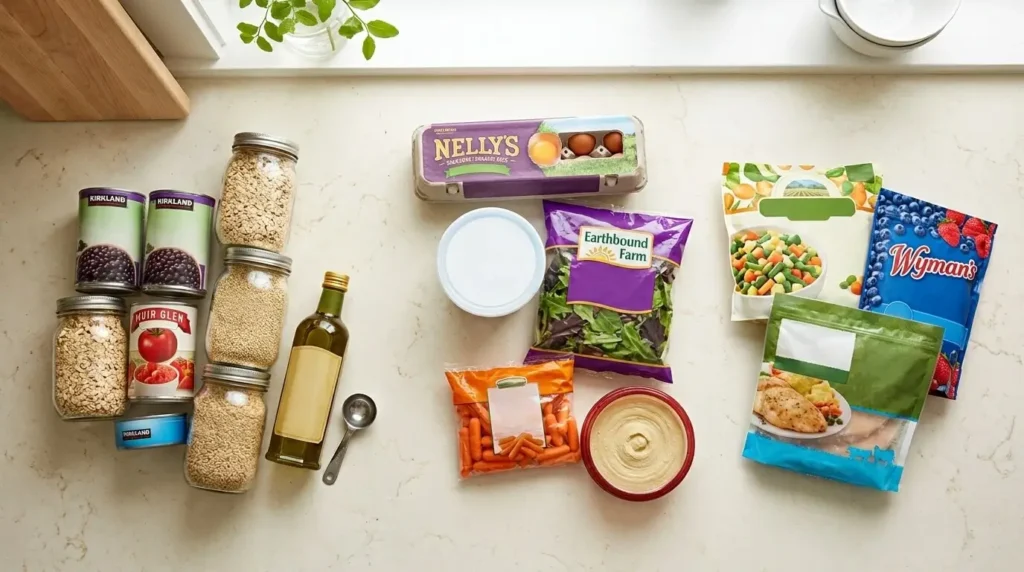
Here’s the truth almost every busy-eating guide skips: healthy eating is won at the grocery store, but not in the kitchen. If the right foods are in your home, you’ll eat them. And if they’re not, no amount of motivation helps at 8 p.m.
Stock these three zones and you can build a healthy meal any day, without a recipe.
Pantry Staples (the shelf-stable backbone)
| Category | Stock These |
| Protein | Canned tuna, salmon, chicken; canned beans, chickpeas and lentils; nut butters; nuts and seeds |
| Smart carbs | Oats, brown rice, quinoa, whole-grain pasta, microwave grain pouches and whole-grain crackers |
| Flavor & fat | Olive oil, canned tomatoes, salsa, spices, honey, low-sodium broth and vinegar |
| Backup produce | Canned or dried fruit (no added sugar) and sun-dried tomatoes |
Fridge Staples (grab-and-go ready)
| Category | Stock These |
| Protein | Eggs, Greek yogurt, cottage cheese, hummus, rotisserie chicken, pre-cooked lentils, cheese |
| Produce | Pre-washed salad, baby spinach, baby carrots, cherry tomatoes, bell peppers, apples and berries |
| Convenience heroes | Pre-chopped veg, microwavable rice, salsa, pesto |
Freezer Staples (the emergency backup)
| Category | Stock These |
| Protein | Frozen chicken breast, shrimp, fish fillets, edamame and veggie burgers |
| Produce | Frozen mixed vegetables, spinach, broccoli, berries, riced cauliflower |
| Fast bases | Frozen brown rice, whole-grain flatbreads and pre-cooked grains |
Frozen produce is just as nutritious as fresh; often more, because it’s frozen at peak ripeness. It never rots, so you waste less food and less money. In my opinion, every busy kitchen should have a loaded freezer.
Key takeaway: A stocked kitchen is a healthy-eating insurance policy. So, set it up once and future-you always has a good option.
The Busy Person’s Grocery Blueprint
Shopping is where most plans quietly fall apart. There you wander the aisles hungry, buy snacks, forget staples and end up with nothing to actually make. Fix it with one rule: shop by category, not by recipe.
Instead of hunting for ingredients for ten specific meals, buy building blocks you can mix and match all week.
The blueprint
- Protein: pick 3-4 (eggs, chicken, canned fish, beans, yogurt)
- Produce: pick 4-5, mixing fresh and frozen so nothing rots
- Smart carbs: pick 2-3 (oats, rice pouches, whole-grain bread)
- Flavor: restock what’s low (olive oil, salsa, spices)
- Backups: a few grab-and-go items (fruit, nuts, string cheese)
Those five categories = dozens of possible meals with zero recipe planning.
Grocery shortcuts that save real time
- Buy pre-washed, pre-chopped and frozen produce without guilt – the small extra cost buys you time and cuts waste
- Grab a rotisserie chicken as an instant protein for 3-4 meals
- Use grocery pickup or delivery to skip the store entirely and avoid impulse buys
- Shop the store perimeter first (produce, protein, dairy); that’s where whole foods usually live
- Read labels for added sugars and sodium; “lower sodium” and “no added sugar” versions of canned goods are easy wins
- Keep a running list on your phone so a shop takes 20 minutes, not an hour
Common mistake: Shopping while hungry. You’ll buy cravings, not staples. Eat something first or shop online.
Quick, Healthy Meals for Every Part of the Day
Now the fun part, actual meals which are sorted by how much time you have. And none of these needs real cooking skills.
Healthy Breakfasts Under 5 Minutes
Quick answer: The fastest healthy breakfasts pair a protein with a fruit or whole grain; think Greek yogurt with berries, overnight oats or eggs on whole-grain toast. Now, aim for protein + fiber to stay full until lunch and avoid the mid-morning crash.
- Greek yogurt bowl – yogurt + berries + a spoon of nut butter or nuts
- Overnight oats – oats + milk + chia + fruit, made the night before (10 seconds in the morning)
- Nut-butter toast – whole-grain toast + peanut butter + banana slices
- Microwave scramble – 2 eggs whisked in a mug, 60 seconds, done
- Grab-and-go – hard-boiled eggs (batch-made) + a piece of fruit
- Smoothie – frozen berries + spinach + yogurt + a splash of milk, blended
Common mistake: Skipping breakfast to save time. It usually backfires; you overeat later. Remember: Even a banana and a handful of nuts beat nothing.
Healthy Lunches Under 10 Minutes
Quick answer: The best fast lunches are assembled, not cooked: a grain bowl, a loaded wrap, a big salad with protein or last night’s leftovers. It’s built around a protein and pile on vegetables so you don’t crash at 3 p.m.
- Grain bowl – microwave rice + canned beans + frozen veg + salsa
- Loaded wrap – whole-grain tortilla + hummus + chicken + spinach
- Big salad – pre-washed greens + canned tuna + chickpeas + olive oil and lemon
- Leftover remix – last night’s dinner over fresh greens
- DIY snack plate – cheese + whole-grain crackers + apple + nuts + baby carrots
- Soup upgrade – a lower-sodium soup + a handful of frozen veg + a scoop of beans
Healthy Dinners Under 20 Minutes
Quick answer: Fast healthy dinners lean on one-pan and one-pot methods: sheet-pan proteins and veg, quick stir-fries or grain bowls. Now, cook a little extra so tomorrow’s lunch is handled.
- Sheet-pan dinner – chicken or fish + chopped veg + olive oil, roasted together
- Stir-fry – frozen stir-fry veg + protein + a splash of soy sauce over rice
- One-pot pasta – whole-grain pasta + canned tomatoes + spinach + beans
- Loaded baked potato – microwaved potato + Greek yogurt + cheese + veg
- Quick tacos – whole-grain tortillas + beans or chicken + salsa + avocado
- Egg dinner – a veggie-packed omelet or frittata (breakfast for dinner counts)
From our kitchen: Our 20-minute dinner recipes are the backbone of this section – one pan, minimal cleanup and real food.
No-Cook Meals for Zero-Energy Days
Some nights you have nothing left. That’s what these are for; no stove, no oven and no problem:
- Tuna or chicken salad in a wrap or over greens
- A hearty snack-plate dinner (protein + cheese + crackers + veg + fruit)
- Hummus + veg + whole-grain pita + olives
- Greek yogurt bowl with granola and fruit (yes, for dinner)
- Overnight oats you made earlier
- Pre-cooked shrimp or rotisserie chicken over a bagged salad kit
Grab-and-Go Snacks That Actually Fill You Up
The secret to a good snack: pair a protein or fat with fiber. That combo keeps you full, unlike a lone handful of crackers.
- Apple + peanut butter
- Greek yogurt + berries
- Handful of nuts + a piece of fruit
- Cheese + whole-grain crackers
- Hummus + baby carrots or cucumber
- Hard-boiled egg + cherry tomatoes
- Edamame (microwave from frozen)
- Roasted chickpeas
Eating Healthy When You’re Not at Home
Real life happens away from your kitchen. Here’s how to stay on track anywhere.
Healthy Eating at Work
The office is a minefield of vending machines, birthday cake and 3 p.m. energy crashes. Win it with prep, not willpower:
- Bring backups. Stash nuts, fruit or protein bars in your desk so you’re never at the mercy of the vending machine.
- Pack the night before. A wrap or grain bowl made at night takes 60 seconds to grab in the morning.
- Prep snacks in bulk. Portion nuts, cut veg and hard-boiled eggs on Sunday.
- Keep a water bottle on your desk. Thirst often masquerades as hunger.
- Have a plan for the shared snack table. Decide before you walk past it, not while you’re standing there.
Healthy Eating While Traveling
Airports, road trips, and hotels don’t have to derail you:
- Pack portable protein: before you leave, have some nuts, jerky, protein bars and roasted chickpeas.
- Buy fruit and yogurt at any airport or gas station instead of chips.
- Request a room with a fridge so you can stock yogurt, fruit and pre-made options.
- Scan the menu for a protein + a vegetable at any restaurant; it’s almost always available.
- Stay hydrated; travel (especially flying) is dehydrating and dehydration feels like hunger.
Smart Restaurant Choices
You can eat out and eat well. Here are a few habits do the heavy lifting:
- Build your order around a protein and vegetables
- Ask for dressings and sauces on the side
- Choose grilled, baked, roasted, or steamed over fried
- Watch portion sizes. Restaurant servings are often two meals; box half right away
- Order water or unsweetened drinks instead of soda
- Start with a broth-based soup or side salad to take the edge off your hunger
Healthy Fast-Food Strategies
No time and only a drive-thru? You can still choose better:
- Grilled over fried (grilled chicken sandwich, not the crispy one)
- Add a side salad or fruit instead of fries when it’s offered
- Skip the sugary drink, because that’s often where most of the calories hide
- Watch the size, as a regular beats a supersize every time
- Add veggies wherever you can (extra lettuce, tomato and a side of veg)
Key takeaway: You don’t need a kitchen to eat well. You just need a default order (protein plus vegetables, water to drink) that you can run anywhere.
Portion Control Without Counting Calories
Quick answer: You can manage portions without tracking a single number by using your plate and your hand as guides: fill half your plate with vegetables, a quarter with protein and a quarter with a smart carb, then eat slowly and stop when you’re satisfied, not stuffed.
Counting calories is tedious and most busy people won’t stick with it. You don’t have to. Use these no-math tricks instead:
- The plate method – half veg, quarter protein and quarter smart carb (from the shortcut above)
- Your hand as a guide – a palm of protein, a fist of veg, a cupped hand of carbs and a thumb of fats
- Eat slowly – it takes about 20 minutes for your brain to register fullness, so slow down and check in
- Use smaller plates – a full smaller plate feels more satisfying than a half-empty large one
- Drink water first – sometimes “hunger” is thirst
A gentle note: If tracking food or portions ever starts to feel stressful or obsessive, that’s worth stepping back from. The goal here is a calmer, easier relationship with food, not stricter rules.
Hydration: The Easiest Health Win
Staying hydrated is one of the simplest things you can do for your energy and it’s easy to forget when you’re busy. Moreover, a mild dehydration can leave you tired, foggy and reaching for snacks you don’t actually need.
Both the latest dietary guidance and common sense point the same way: make water (still or sparkling) your default drink and skip the sugary sodas, sweetened coffees and energy drinks that pile on added sugar.
Easy habits:
- Keep a water bottle wherever you spend your day
- Drink a glass with each meal as an automatic reminder
- Flavor it naturally with lemon, cucumber or berries if plain water bores you
- Swap one sugary drink a day for water a small change with a big yearly payoff
- Check in when you feel snacky a glass of water first tells you if it was real hunger
Key takeaway: Start with water. It’s free, it’s fast and it quietly fixes energy dips you were blaming on food.
The One-Hour Weekly Meal Prep
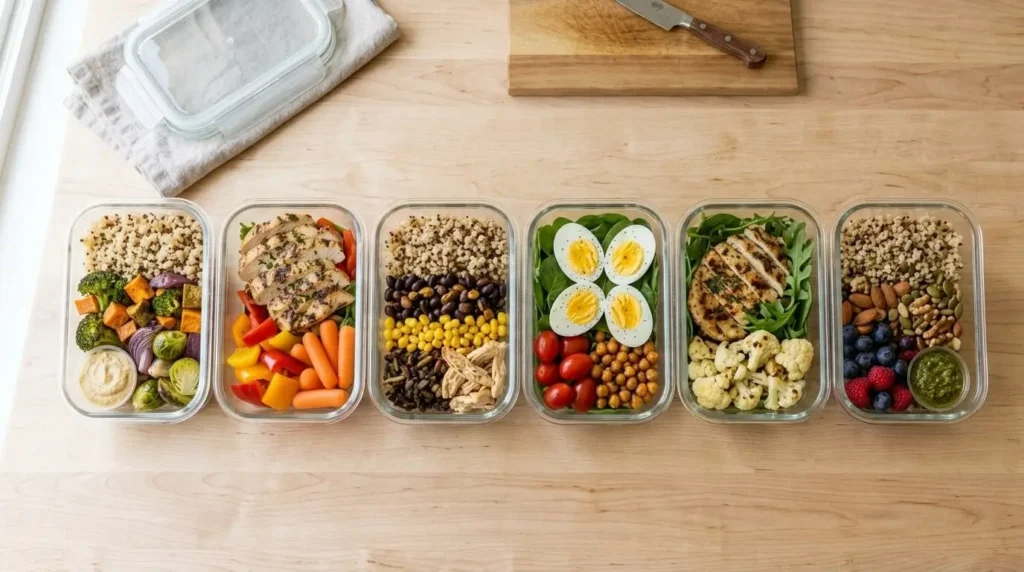
You don’t need to spend Sunday cooking twelve containers of identical chicken and rice. That burns people out. Instead, spend one hour prepping building blocks; then assemble fresh meals all week.
Set a timer for 60 minutes and do as much of this as you can:
- Cook one protein – roast a tray of chicken, hard-boil a dozen eggs or cook a pot of lentils (15 min hands-on)
- Cook one grain – a batch of rice or quinoa for the week (5 min hands-on)
- Roast a tray of vegetables – whatever’s in the fridge, tossed in olive oil (5 min hands-on)
- Wash and chop grab-and-go produce – carrots, peppers and cucumber (15 min)
- Portion snacks – nuts, cut fruit and yogurt cups (10 min)
- Make a few overnight oats or salad jars for the busiest mornings (10 min)
Now your week is a mix-and-match game. Protein + grain + veg + a new sauce each day keeps it from getting boring, without cooking from scratch every night.
From our kitchen: Our meal prep recipes are built for this exact one-hour approach, with components, not rigid daily meals.
Key takeaway: Prep ingredients, not meals. As building blocks give you variety and speed; identical containers give you burnout.
Eating Healthy on a Budget
Healthy and cheap aren’t opposites; a lot of the healthiest foods are the most affordable. Here’s how to eat well without overspending:
- Buy the budget proteins: eggs, canned tuna and salmon, beans, lentils and chickpeas cost pennies per serving
- Choose frozen produce: cheaper than fresh, lasts for months, zero waste
- Cook once, eat twice: leftovers are the cheapest meal you’ll ever make
- Buy staples in bulk: oats, rice, dried beans, and frozen veg have a low cost per serving
- Skip pre-packaged single servings: portion them yourself into reusable containers
- Plan around what’s on sale: build your week’s meals from discounted produce and proteins
- Waste less: a stocked freezer and a shopping list are your best money-savers
Beans, lentils, oats, eggs, frozen vegetables and seasonal produce form the backbone of a healthy diet and a cheap one.
The Emergency Healthy Eating System
Quick answer: An emergency meal system is a small set of no-effort backup meals you keep stocked at all times, so that even on your worst day and you have a healthy option ready. It’s the single best defense against the “there’s nothing to eat, let’s order takeout” spiral.
Every busy person needs backup meals; the healthy equivalent of a spare tire. These live in your pantry, fridge and freezer at all times. Which are ready for the day when cooking simply isn’t going to happen.
Your emergency backup list
| Zone | Emergency Meal |
| Pantry | Canned tuna or beans + whole-grain crackers + olive oil; a quick lentil soup |
| Fridge | Greek yogurt + fruit + nuts; a wrap with hummus and whatever veg is left |
| Freezer | Frozen veggie stir-fry + frozen rice; a veggie burger + frozen vegetables |
| Zero effort | Nut butter + banana + a glass of milk; a smoothie |
Keep at least three emergency meals stocked at all times. Then restock them the moment you use one. Because this one habit prevents more bad-food decisions than almost anything else, because the failure point for busy people is always the empty-fridge, no-plan moment.
Key takeaway: Decide your backup meals before the crisis hits. Future-you, tired and hungry, will thank present-you.
Your Weekly Healthy Eating Routine
Put it all together into a light rhythm; not a rigid schedule, just a loose flow that keeps the system running:
- Weekend (or your day off): 20-minute grocery shop + 1-hour prep of building blocks
- Weekday mornings: Grab a pre-made or 5-minute breakfast; refill your water bottle
- Weekday lunches: Assemble from your building blocks or remix leftovers
- Weekday dinners: Run the decision tree – 20-minute cook, or assemble, or emergency backup
- All week: Snack on prepped grab-and-go options; drink water; aim for the Minimum Viable Healthy Day
- Anytime you use a backup meal: Add it to your list to restock
That’s the whole system. Shop, prep a little, assemble a lot and keep backups ready.
The Printable Busy-Day Checklist
Screenshot this or print it for your fridge.
Daily
- [ ] Ate breakfast (didn’t skip)
- [ ] Protein at each meal
- [ ] At least 2 servings of fruit or veg
- [ ] Water bottle refilled (aim: a few times)
- [ ] Swapped at least one sugary drink for water
Weekly
- [ ] Grocery shop done (shopped by category)
- [ ] One hour of prep (protein + grain + veg + snacks)
- [ ] 3 emergency backup meals stocked
- [ ] Freezer has frozen veg + a frozen protein
- [ ] Restocked anything I ran out of
Hit most of these most days and you’re eating healthier than the vast majority of busy people. Not perfectly, but consistently. And that’s the goal.
Your 7-Day Action Plan
Don’t try to change everything at once; that’s how people quit. Do one small thing a day:
- Day 1: Stock 3 emergency backup meals.
- Day 2: Do a 20-minute grocery shop using the category blueprint.
- Day 3: Memorize the 5-Minute Formula (protein + produce + smart carb + flavor).
- Day 4: Swap one sugary drink for water. Keep a bottle nearby.
- Day 5: Do a one-hour prep session; one protein, one grain and one tray of veg.
- Day 6: Print the decision tree and checklist for your fridge.
- Day 7: Plan next week’s shop. Then notice what worked and repeat it.
One week in, you’ll have a stocked kitchen, prepped food and a system that runs itself. That’s not a diet, but a new default.
Key Takeaways
- Time (not willpower) is the real barrier, so remove the friction between you and a healthy meal.
- Aim for progress, not perfection. A “good enough” meal you’ll eat beats a perfect one you won’t make.
- Assemble, don’t cook. Protein + produce + smart carb + flavor = a real meal in five minutes.
- Win at the grocery store. A stocked pantry, fridge, and freezer mean you always have a good option.
- Keep emergency backups. Decide on your no-effort meals before the busy day hits.
- Prep building blocks, not identical meals. One hour a week buys you variety and speed.
- Start with water. It’s the easiest health win there is.
You don’t need more time. You need a system. Now you have one.
Ready to start? Explore quick, healthy recipes for every part of your day on our homepage, where everything’s built for people who are nourished but in a hurry.
Frequently Asked Questions
How can I eat healthy if I have absolutely no time to cook?
Focus on assembling meals instead of cooking them. Keep your kitchen stocked with grab-and-go proteins (such as Greek yogurt, canned tuna, rotisserie chicken and eggs), pre-washed produce and whole-grain carbs. Combine one from each group plus a splash of flavor and you have a balanced meal in about five minutes, no stove required.
What’s the healthiest fast breakfast?
Anything that pairs protein with fiber to keep you full. Additionally, Greek yogurt with berries, overnight oats, nut-butter toast with banana or eggs scrambled in the microwave all take under five minutes and beat a pastry or skipping breakfast entirely.
Is it better to skip a meal or eat something unhealthy when I’m busy?
Usually, neither is ideal, but skipping often backfires you get hungrier and overeat junk later. Reach for a simple backup instead: a piece of fruit with nuts, a yogurt or a wrap. Additionally keeping easy options on hand prevents the choice from ever being “skip or junk.”
How do I eat healthy on a tight budget?
Build meals around cheap, nutritious staples: eggs, beans, lentils, canned fish, oats, frozen vegetables and seasonal produce. Cook once and eat twice, buy staples in bulk and choose frozen produce so nothing goes to waste. Remember: Healthy eating is often cheaper than takeout.
Is frozen produce as healthy as fresh?
Yes, frozen fruits and vegetables are frozen at peak ripeness, so they keep their nutrients – sometimes even better than fresh produce that’s sat around for days. They also last for months and cut down on waste, which makes them ideal for busy kitchens.
How can I control portions without counting calories?
Use the plate method: fill half your plate with vegetables, a quarter with protein and a quarter with a whole grain. Your hand works too: a palm of protein, a fist of veg and a cupped hand of mojiocarbs. You have to eat slowly and stop when you’re satisfied rather than stuffed.
How do I stay consistent with healthy eating?
Lower the bar and build systems. First, define a “Minimum Viable Healthy Day” you can hit even when everything goes wrong, keep emergency backup meals stocked and prep building blocks once a week. Consistency comes from making the healthy choice the easy choice, not from motivation.
What should I keep stocked for busy weeks?
Stock all three zones: pantry (canned beans and fish, oats, rice pouches, olive oil), fridge (eggs, Greek yogurt, pre-washed greens, hummus) and freezer (frozen vegetables, frozen protein, frozen grains). With these on hand, you can build a healthy meal any day without a recipe.
A Quick Note
This guide is for general education and to help you build practical, everyday eating habits. It isn’t personalized medical or nutrition advice. If you have a health condition, specific dietary needs, or questions about what’s right for your body, it’s always best to check with a doctor or a registered dietitian.
8 thoughts on “How to Eat Healthy When You Have No Time (Real Strategies That Actually Work)”