
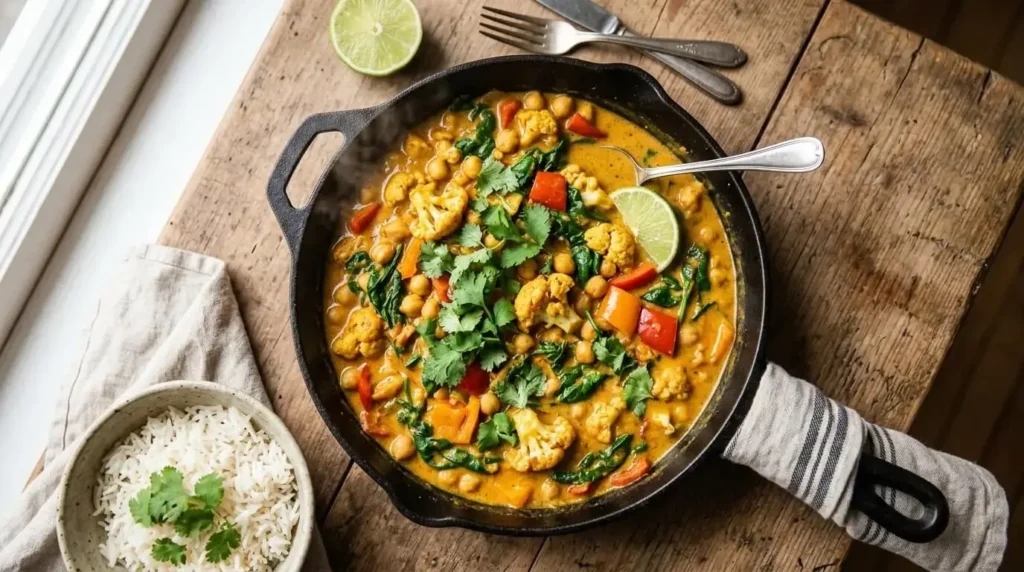
This vegan coconut curry comes together in one pot in about 30 minutes with chickpeas, a mix of vegetables and a creamy coconut milk sauce built from a handful of pantry spices. It’s an easy entry point if you’re new to curry. Every step tells you exactly why it’s happening so you’re not guessing at timing or texture. No stovetop juggling just one pan from aromatics to dinner.
Quick Answer
To make vegan coconut curry, sauté onion, garlic & ginger then bloom curry powder, cumin and turmeric in the hot oil. Add firm vegetables like cauliflower then stir in tomatoes, chickpeas, coconut milk and broth. Simmer until the vegetables are tender stir in spinach then finish with lime juice and salt to taste. The whole process happens in one pot in about 30 minutes.
Why This One-Pot Vegan Coconut Curry Works
Everything happens in a single skillet or wide pot. No separate pan for spices no extra saucepan for sauce. That makes this a genuine addition to your one-pot meals rotation and at around 30 minutes start to finish It fits alongside your favorite 20-minute meals for busy weeknights. Chickpeas add substance and plant-based protein, hearty vegetables add texture and color and full fat coconut milk turns the broth into a rich coatable sauce without any dairy. The spice blend is short and pantry-friendly – curry powder, cumin and turmeric do most of the work. If you’re building a vegan recipes rotation, this coconut chickpea curry is a reliable one to keep in the mix.
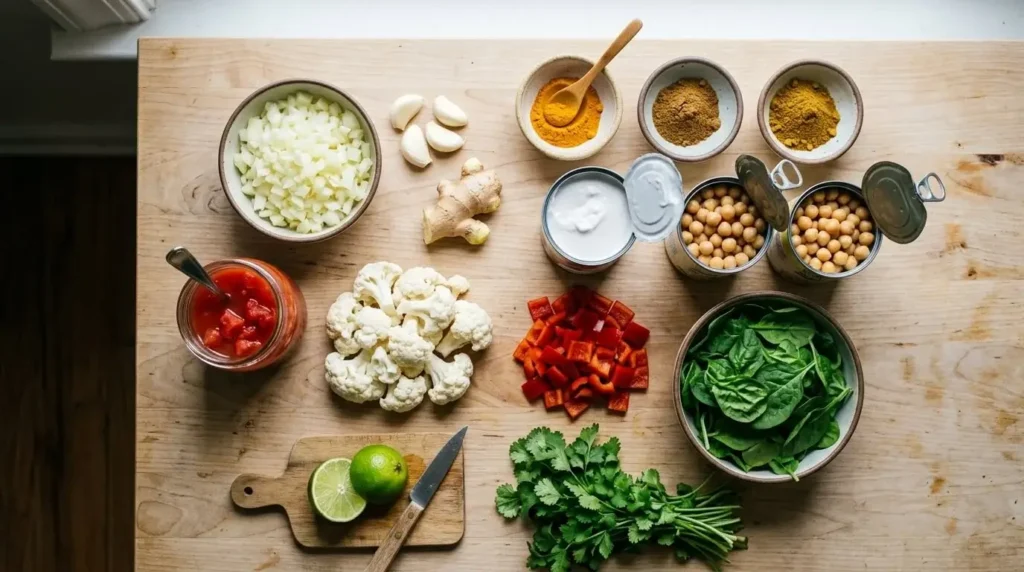
What You Need
This vegetable coconut curry keeps its ingredient list short and easy to shop for.
Full-Fat vs Light vs Carton Coconut Milk
Canned coconut milk and the refrigerated coconut beverage sold near dairy alternatives are not interchangeable; they behave very differently in a simmering sauce and the type you use is often what separates a good coconut milk curry from a thin forgettable one.
| Coconut product | Result | Recommendation |
| Full-fat canned coconut milk | Thick, rich, creamy sauce that holds up to simmering | Best choice for this recipe |
| Light canned coconut milk | Thinner sauce, less richness, still coconut-forward | Fine if you want a lighter curry |
| Carton coconut beverage (refrigerated) | Very thin, watery sauce that won’t thicken properly | Avoid for this recipe |
Chickpeas and Vegetables
Use canned chickpeas then drained and rinsed to remove excess sodium and canning liquid. For vegetables first firm ones like cauliflower go in earlier so they have time to soften quick-cooking vegetables like bell pepper go in with the sauce and spinach goes in last so it wilts instead of turning to mush.
Cooking-Method Decision Guide
A few quick decisions up front – including how you build a vegetable curry with coconut milk – save you from adjusting mid-simmer.
| If you want… | Choose… | Why |
| The richest, creamiest sauce | Full-fat canned coconut milk | Higher fat content holds together under heat |
| A lighter curry | Light canned coconut milk | Thinner texture, less richness, still balanced with spices |
| Less chopping | Frozen cauliflower, peas, and diced vegetables | Cooks at nearly the same speed as fresh |
| A protein that holds its shape | Canned chickpeas | Stays intact through a full simmer |
| Even heat and more surface area | A large deep skillet or wide pot | Vegetables cook more evenly than in a narrow pot |
| Vegetables that aren’t crunchy or mushy | Firm vegetables added early, quick vegetables added late | Everything finishes tender at the same time |
Stick with these defaults the first time, then adjust once you know how your stove runs.
How to Make Vegan Coconut Curry
1. Soften the Aromatics
Heat olive oil in a large deep skillet over medium heat. Add the onion and cook until soft and translucent, 4 to 5 minutes – edges golden, not brown. This base carries the spices later, so don’t rush it. Add the garlic and ginger and cook for 30 seconds until fragrant.
2. Bloom the Curry Spices
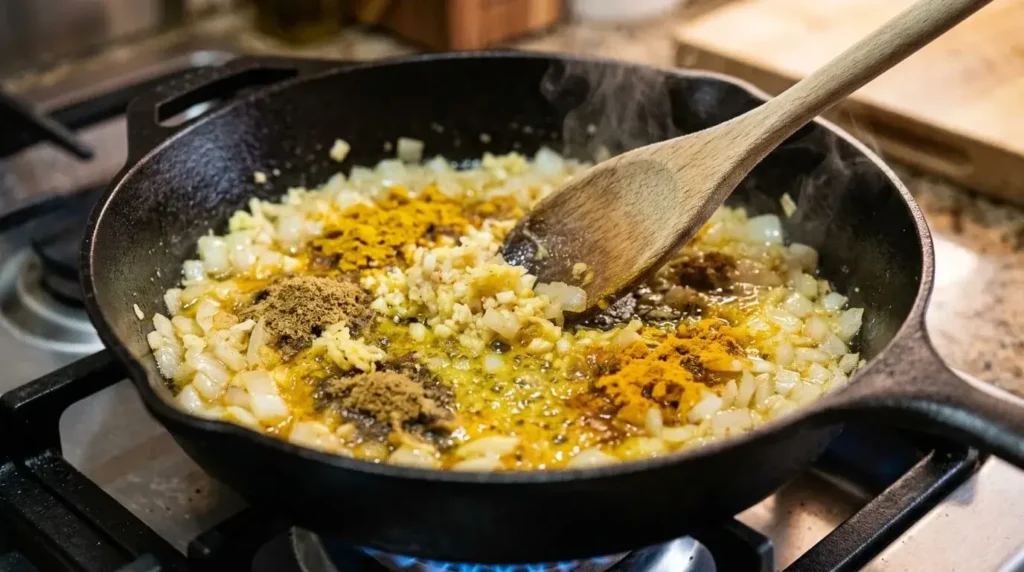
Add the curry powder, cumin, turmeric, and cayenne, if using and stir constantly for 30 to 45 seconds. This is spice blooming – the dry spices toast in the residual oil, waking up their flavor before any liquid goes in. Keep the heat at medium; scorched spices turn bitter fast, so pull the pan off heat for a few seconds if it starts to smoke.
3. Add the Firm Vegetables
Stir in the cauliflower and bell pepper and toss to coat in the spices. These go in before the liquid because they need the longest cooking time to soften – adding them later leaves crunchy bites in an otherwise soft curry.
4. Build the Coconut Curry Sauce
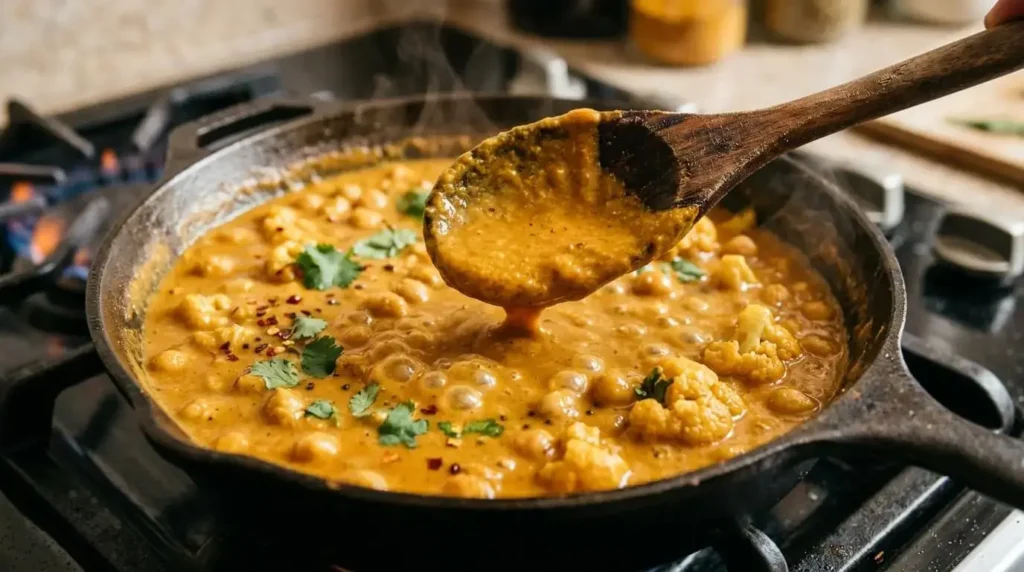
Add the tomatoes, chickpeas, coconut milk, and vegetable broth and stir together. Bring to a gentle simmer – small bubbles, not a rolling boil, which can separate the coconut milk. Cover and simmer for 7 to 9 minutes, until the cauliflower is fork-tender. Check by texture since vegetable size varies from one kitchen to the next.
5. Finish With Quick-Cooking Vegetables
Remove the lid and stir in the spinach – I like adding most of it here, then a final handful right before serving, so you still see bright green rather than everything wilting into the sauce. Cook for 1 to 2 minutes, just until wilted. Greens go in last because extra simmering turns them dull and overcooked. You want bright color not a slimy texture.
6. Balance the Flavor
Turn off the heat before adjusting the seasoning residual heat and keep cooking the sauce while you taste. Start with salt since it sharpens every other flavor. Add lime juice next for acidity, which cuts the richness of the coconut milk. Adjust heat with extra cayenne if you want it spicier and add a touch of sweetness a pinch of sugar or maple syrup only if the curry tastes flat. Stir in the cilantro last.
Vegetable Timing & Doneness Guide
Vegetable size changes cooking time more than the vegetable itself. Smaller pieces of any vegetable will always finish faster than large chunks.
| Ingredient | When to add | Doneness cue |
| Cauliflower | With the firm vegetables before the sauce | Fork slides in slight resistance |
| Carrot | With the firm vegetables before the sauce | Fork slides in easily |
| Sweet potato | With the firm vegetables before the sauce | Fork slides in, edges softening |
| Broccoli | A few minutes before the simmer ends | Bright green still firm |
| Bell pepper | With the quick vegetables near the end | Softened holds its shape |
| Peas | With the spinach at the very end | Bright green heated through |
| Spinach | Last right before serving | Just wilted still bright |
| Stage | Visual/texture endpoint | Temperature |
| Firm vegetables simmering | Slight fork resistance, not raw crunch | Judge by texture not a number |
| Finished curry | Sauce coats a spoon, vegetables tender | Judge by texture and color |
| Reheated leftovers | Steaming throughout, no cold center | 165°F |
How to Fix Common Vegan Coconut Curry Problems
Even a straightforward curry can go sideways in small ways. Here’s how to fix the most common issues.
| Problem | Likely cause | Fix |
| Watery curry | Too much broth or coconut milk that was mostly liquid | Simmer uncovered a few extra minutes to reduce or stir in a spoonful of tomato paste |
| Too-thick curry | Too little liquid or reduced too long | Stir in a splash of broth or water, a tablespoon at a time |
| Bland curry | Under-salted or spices weren’t bloomed long enough | Add salt in small increments a squeeze of extra lime often fixes flat flavor |
| Too spicy | Cayenne added too generously | Stir in a spoonful of coconut milk or a pinch of sugar or serve over extra rice |
| Crunchy vegetables | Added too late or cut too large | Simmer covered a few more minutes, checking every 2 minutes |
| Separated coconut milk | Boiled too hard or simmered uncovered too long at high heat | Lower the heat immediately whisk gently and avoid a rolling boil going forward |
Most of these are easy mid-cook corrections rather than reasons to start again.
Substitutions
Coconut Milk Substitutions
Full-fat canned coconut milk gives the creamiest, most stable sauce for this coconut milk curry. Light canned coconut milk works but yields a thinner curry. Coconut cream makes an even richer sauce if thinned with extra broth. Carton coconut beverage isn’t a good substitute – it’s too thin to build a proper sauce.
Protein Substitutions
Chickpeas can be swapped for cooked lentils though lentils cook faster and should go in with the sauce not the firm vegetables. Cubed tofu holds its shape and can go in with the chickpeas. Tempeh has a firmer meatier bite and benefits from a quick pan-sear first. White beans are a near one-to-one swap for a chickpea curry base, with no timing changes. If you like cooking with a can of chickpeas midweek our vegan chickpea stir-fry is another fast option to keep in rotation.
Vegetable Substitutions
Frozen vegetables can replace fresh broccoli, cauliflower, carrots, peas or sweet potato. Add them straight from the freezer but expect a couple of extra minutes of simmering since they lower the pan’s temperature. Different vegetables still cook at different rates so don’t assume a one-to-one swap in timing.
What to Serve With Vegan Coconut Curry
Basmati rice is the classic pairing – it stays fluffy and separates well under a wet curry. Jasmine rice works too with a softer, slightly stickier bite. Brown rice adds more fiber if you want a heartier bowl though it takes longer to cook so plan ahead or use a pre-cooked pouch. Quinoa is a good high-protein option and cauliflower rice or zucchini noodles keep things low-carb. Warm vegan naan is best when you want something to scoop with. Pick based on what you already have on hand – the curry works with all of them.
Storage & Reheating
Refrigerator Storage
Cool the curry down and refrigerate leftovers promptly and plan to eat them within 3 to 4 days – general food-safety guidance for cooked vegetable and legume dishes points to this window as a safe upper limit.
Reheating
Reheat gently on the stovetop over medium-low heat adding a splash of water or broth since the sauce thickens as it chills. In the microwave reheat in short intervals, stirring between each, for the same reason. Either way, leftovers should be reheated until steaming hot all the way through reaching an internal temperature of 165°F before eating.
Freezing
This particular version has not been tested through a freeze-and-thaw cycle so I can’t confirm how the texture holds up coconut-based sauces can sometimes separate slightly after freezing. If you want to try it anyway freeze in a single layer first and expect to stir the sauce back together as it reheats.
Meal Prep Notes
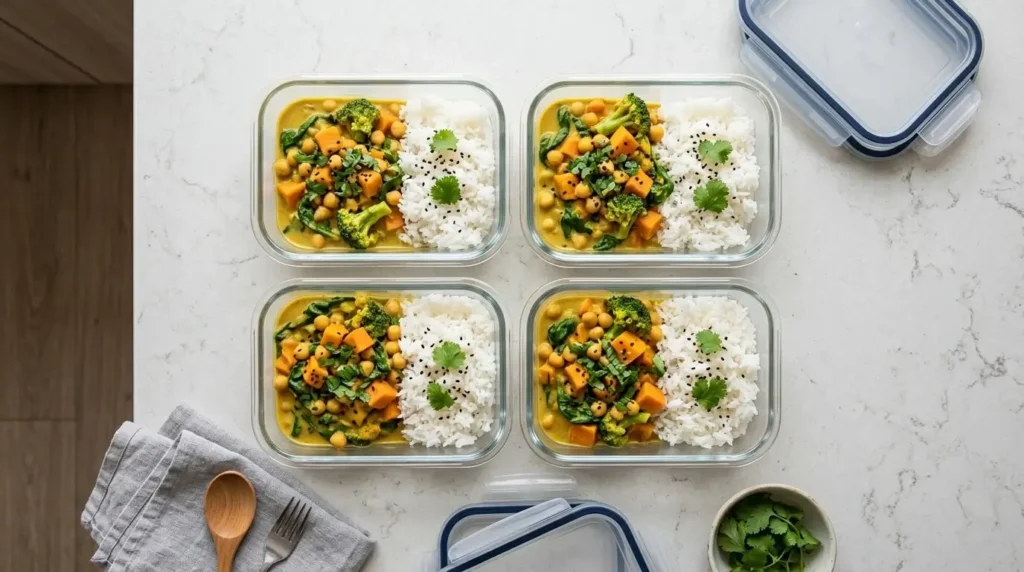
This curry holds up well for weekday lunches. Cook the full batch then let it cool at room temperature for a short window before portioning it into containers cooling it down promptly matters more than any other single step for food safety. Store rice separately where you can so it doesn’t turn mushy sitting in the sauce. Reheat gently adding a splash of broth as needed, and stir in fresh lime juice and cilantro after reheating rather than before since both fade with time. If you’re building a weekly rotation, this fits well alongside our meal prep recipes and our guide to meal prepping for beginners covers portioning and container basics in more depth.
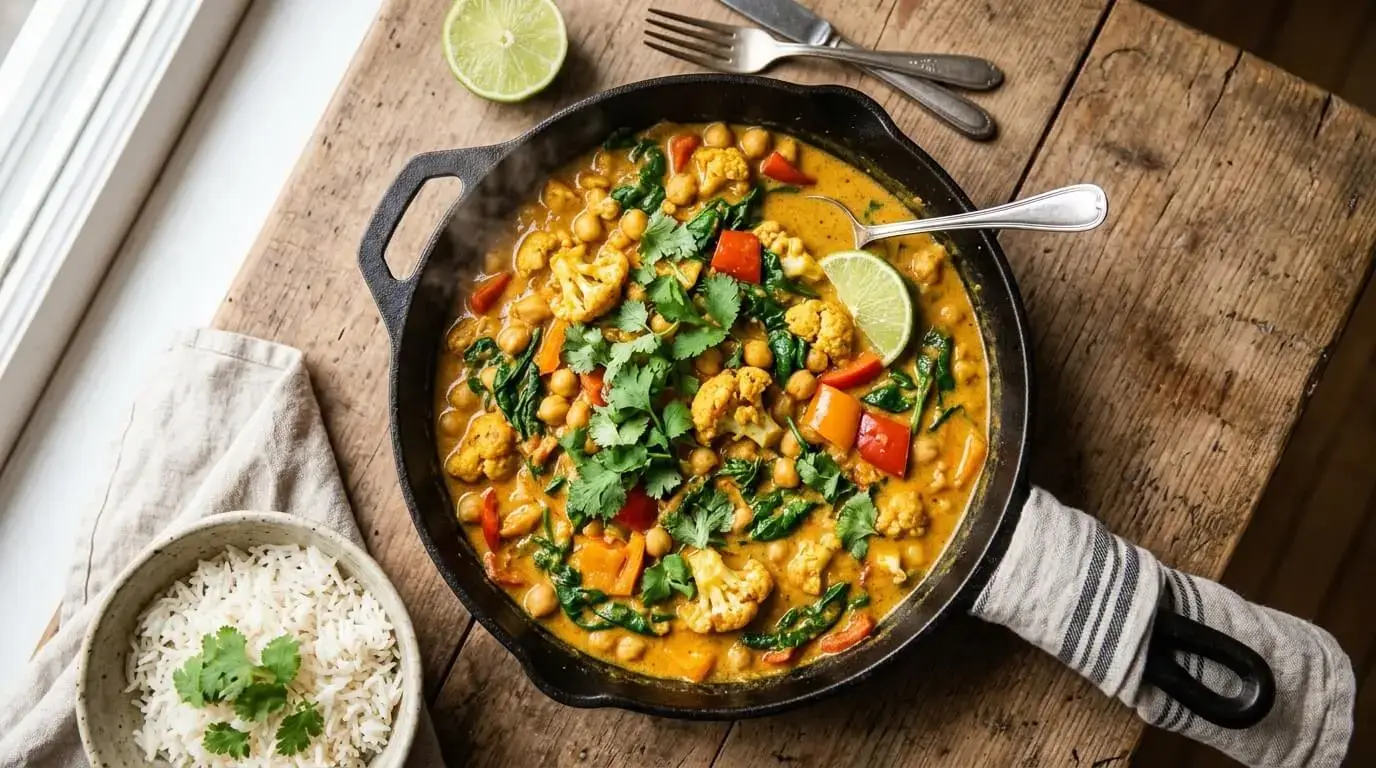
One-Pot Vegan Coconut Curry
Ingredients
Method
- Heat oil in a large deep skillet or wide pot over medium heat. Add onion and cook until softened, about 4–5 minutes.
- Add garlic and ginger and cook for about 30 seconds, until fragrant.
- Add curry powder, cumin, turmeric, and optional cayenne. Stir for 30–45 seconds to bloom the spices without burning them.
- Add cauliflower and bell pepper and stir to coat.
- Add tomatoes, chickpeas, coconut milk, and vegetable broth. Stir and bring to a gentle simmer.
- Cover and simmer until the firm vegetables are tender, about 7–9 minutes. Check texture rather than relying only on the clock.
- Remove the lid and add spinach. Cook for 1–2 minutes until just wilted.
- Turn off the heat. Stir in lime juice and cilantro. Taste and adjust salt, lime, or heat.
- Serve immediately or store according to the storage instructions above.
Notes
- Coconut milk: Use full-fat canned coconut milk for the creamiest sauce. Light canned works but gives a thinner curry. Refrigerated carton coconut beverage is too thin for this recipe.
- Simmer gently: Keep the curry at a gentle simmer with small bubbles. A hard boil can make the coconut milk separate.
- Vegetable timing: Check the cauliflower with a fork rather than relying only on the clock. Smaller pieces cook faster, and larger pieces need a few extra minutes.
- Spinach: Add it at the end so it wilts without turning dull. Stir in the lime juice and cilantro after turning off the heat.
- Too thick or too thin: If the curry is too thick, stir in a splash of broth or water. If it’s watery, simmer uncovered for a few more minutes.
- Frozen vegetables: Add them straight from the freezer and allow a couple of extra minutes of simmering.
- Protein swaps: Cooked lentils and white beans work in place of chickpeas. Lentils cook faster, so add them with the sauce.
- Serving: Serve over basmati, jasmine, or brown rice, quinoa, or cauliflower rice, or with vegan naan. Rice and naan are optional sides, and the curry itself is one pot.
- Storage: Refrigerate leftovers promptly and eat within 3-4 days. The sauce thickens as it chills, so add a splash of water or broth when reheating.
- Reheating: Reheat leftovers until steaming hot, to an internal temperature of 165°F.
- Freezing: This recipe hasn’t been tested for freezing.
| Nutrient | Approx. per serving |
| Calories | ~450–475 kcal |
| Protein | ~14–16 g |
| Carbohydrates | ~44–48 g |
| Fiber | ~11–13 g |
| Fat | ~26–28 g |
Nutritional Information
Exact nutrition facts for this recipe will be calculated automatically once the final ingredient quantities are entered into the recipe plugin and will appear in the card below. In general terms chickpeas are a good source of plant protein and fiber which lines up with broader nutrition guidance on legumes as a plant-based protein source. Coconut milk contributes fat which is part of what makes the sauce creamy and satisfying. As always the numbers will vary depending on the specific brands and quantities used.
Nutrition is an estimate and will vary depending on ingredients and brands used.
Frequently Asked Questions
Is coconut curry vegan?
Coconut curry itself is easy to make fully vegan since the creaminess comes from coconut milk instead of dairy or yogurt. Many restaurant and packaged versions use chicken or fish-based broths, though so always check the ingredient list. This recipe uses vegetable broth and canned chickpeas to keep every ingredient plant-based.
Can I use light coconut milk in vegan coconut curry?
Yes. Light coconut milk works fine and produces a thinner less rich sauce than full-fat canned coconut milk. The flavor stays balanced since the spices carry most of it but if you want the classic creamy consistency shown in this recipe full-fat canned coconut milk is the better choice.
Can I use carton coconut milk instead of canned?
Not for this recipe. Carton coconut beverage the kind sold refrigerated near dairy alternatives, is much thinner than canned coconut milk and won’t thicken into a proper sauce no matter how long you simmer it. Stick with canned coconut milk, full-fat or light, for a sauce that actually coats the vegetables.
Why is my coconut curry watery?
Usually it’s too much broth relative to coconut milk or a can of coconut milk that separated into mostly liquid before you shook it. Simmer the curry uncovered for a few extra minutes to let excess liquid reduce or stir in a spoonful of tomato paste to thicken it without diluting the flavor.
How do I stop coconut milk from separating?
Coconut milk separates when a curry boils too hard or simmers uncovered at high heat for too long. Keep the heat at medium-low once the coconut milk goes in aim for small, gentle bubbles rather than a rolling boil and stir occasionally so the fat doesn’t break away from the liquid.
What vegetables go well in coconut curry?
Firm vegetables like cauliflower, carrots and sweet potato hold up well to a full simmer while quicker vegetables like bell pepper, peas, and broccoli only need a few minutes. Spinach and other leafy greens should go in right at the end so they wilt without turning mushy or losing their color.
Can I substitute chickpeas in vegan coconut curry?
Yes. Cooked lentils, cubed tofu, tempeh or white beans all work in place of chickpeas. Lentils cook faster and should go in with the sauce rather than earlier, tofu holds its shape well and tempeh benefits from a quick sear first. White beans are close to a one-to-one swap with no timing changes.
How long does vegan coconut curry last in the fridge?
Refrigerate leftovers promptly and plan to eat them within 3 to 4 days which lines up with general food-safety guidance for cooked vegetable and legume dishes. Reheat leftovers until they’re steaming hot throughout, reaching an internal temperature of 165°F, whether you’re using the stovetop or the microwave.
1 thought on “Vegan Coconut Curry”